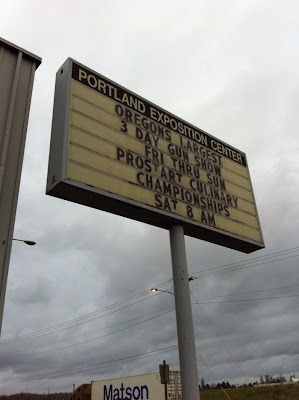
Portland’s Yard Garden and Patio show was this weekend, which always signals to me the beginning of the gardening season. The display gardens are fun but I look forward to the seminars most of all. I woke up on Saturday with a terrible sinus headache, then I took medicine on an insufficiently full stomach, then I started throwing up . . . I realized that the show just wasn’t going to happen that day. So Sunday it was!
I made it to only one seminar: “The birds and the bees – and the bugs!” which was moderated by Nancy Goldman (of Nancyland). The panel included Glen Andresen or Bridgetown Bees, Matthew Shepherd of the Xerces Society, and Nikkie West of the Audubon Society. So we had a honeybee keeper, someone focused on native pollinators, and a bird expert.
There was a lot of conversation volleying around about honeybees versus native pollinators and whether we should care about honeybees (who are not native to North America), none of which was resolved in an hour. The one thing that the panel could agree on was that native plants provide the best nectar for native pollinators. Most of our native pollinators are solitary, which makes it hard to study them like we do honeybees. They don’t produce honey, so it’s harder to evaluate the quality of their diet like we do honeybees but preliminary studies are showing that non-native plants are a bit like junk food. They provide energy but not necessarily as much nutritional value as natives.
But I don’t want to become a native purist! I can hear you saying. Me neither!
Here were some of the takeaways:
- You don’t need to have all natives in your garden. You can get a lot of bang for your buck by making sure you have one native in bloom at any time throughout the year. In theory you could get away with including just four or five natives in your garden.
- But which ones? For those of us in the NW, The Xerces Society has created a document highlighting some of the best of the natives with their bloom times. It’s located here. The best part? They are some of the prettiest natives like lupines, camassia, and milkweed.
 |
| Camassia leichtlinii ‘Blue Danube’ handles soggy clay soils like a champ and it’s GORGEOUS. |
- The city of Portland maintains a list of natives to our city, so you can claim to have planted hyperlocal natives. Think of how miserable you can be at dinner parties! The list is located here. Go get your smug on!
- If you want to provide shelter for mason bees, less is more. Smaller boxes or bundles of bamboo (or whatever) in several locations around your garden are better than having one gigantic box. When you get a lot of pollinators in one spot you increase the chance of disease and pestilence. 8-10 holes are plenty.
- Bumblebees need cavities to nest in, like old mice nests. Xerces has instructions on building boxes, if you want a fun project.
- Keeping your garden untidy is a good thing. Bare soil, just a little, allows bees access so they can build underground nests. When you cut back grasses and perennials, bundling them and leaving them on the ground instead of composting them gives pollinators habitat to raise their young. Glen calls it “Laissez faire/laissez ass” gardening.
- We need to look at aphids differently. 96% of terrestrial bird species feed on aphids. They are an important food source, so having them in our gardens isn’t a bad thing.

 |
| Meadow foam (Limnanthes douglasii) is available from Annie’s Annuals |